# Are BTC ETF Managers Doing A Good Job (Part 2)?
Source: https://www.yieldcurve.pro/blog/btc-etf-tracking-error-002
Published: 2026-09-23
Tags: ARK, ARKB, BITB, BRRR, BTCO, BTCW, Beta, Bitcoin, Bitwise, Drawdown, ETFs, EZBC, FBTC, Fidelity, Franklin Templeton, GBTC, Grayscale, HODL, IBIT, IVV, Invesco, SPY, Tracking Error, VOO, Valkyrie, VanEck, WisdomTree, iShares
_We got our initial study wrong. We're owning up to it and fixing the analysis._
---
title: Are Bitcoin ETF Managers Doing A Good Job (Part 2)?
synopsis: We got our initial study wrong. We're owning up to it and fixing the analysis.
tags: ARK, ARKB, BITB, BRRR, BTCO, BTCW, Beta, Bitcoin, Bitwise, Drawdown, ETFs, EZBC, FBTC, Fidelity, Franklin Templeton, GBTC, Grayscale, HODL, IBIT, IVV, Invesco, SPY, Tracking Error, VOO, Valkyrie, VanEck, WisdomTree, iShares
slug: btc-etf-tracking-error-002
date: 2026-09-22
---
# Are BTC ETF Managers Doing A Good Job (Part 2)?
[Part 1](https://www.yieldcurve.pro/blog/btc-etf-tracking-error-001) concluded with
us proclaiming that either the current stable of Bitcoin ETF managers were doing a
shit job or our tracking error analysis was off. Well...it was the analysis. We
compared ETF closing prices set at 4pm EST against a Bitcoin price stamped at midnight
UTC. Bitcoin trades for another three or four hours in between.
Two and a half years of additional data let us do the job properly this time.
The sample below runs from January 11, 2024 (the first day of trading) through
September 21, 2026 for a total of 675 observations.
As a reminder, tracking error is the annualized standard deviation of the
difference between a fund's daily return and its benchmark's.
## The Clock
The bitcoin data for our first blog post came from Yahoo Finance, whose daily
close is the last price before midnight UTC. That is 7pm EST or 8pm during day
light saving time. Bitcoin at 49% annualized volatility moves plenty in those
hours. This time we took bitcoin prices from Coinbase at the same time ETF trading
closes. We call this series "Bitcoin at the close".
## The Rerun
We ran the original analysis through the original full sample of data. Then
we ran the same code against "Bitcoin at the close". Table 1 shows the results.
| Symbol | Midnight UTC | At the close |
|:-------|------------:|-------------:|
| IBIT | 20.84% | 1.37% |
| FBTC | 20.79% | 1.34% |
| GBTC | 20.77% | 1.19% |
| ARKB | 20.77% | 1.28% |
| BITB | 20.67% | 1.10% |
| HODL | 20.66% | 1.39% |
| BRRR | 20.64% | 1.13% |
| BTCO | 20.66% | 1.30% |
| EZBC | 20.71% | 1.39% |
| BTCW | 20.81% | 1.75% |
*Table 1: Annualized tracking errors: flawed vs updated.*
Beta tells the same story. Beta is the slope from regressing a asset's daily
returns on another target asset. Against "Bitcoin at the close" the ten funds have
betas of 1.000 to 1.009 and correlations of 0.999 or better. Against the original
Yahoo price series they had a beta of 0.93 and a correlation of 0.91.
The original post noted that tracking error "increased steadily" through early 2024
while blamed rising volatility. The cause was arithmetic. We originally used a rolling
252-day window but let it report after only 30 days. The early values rested
on only a few observations. Figure 1 uses the same lookback window but waits for
at leaset 120 days of history.
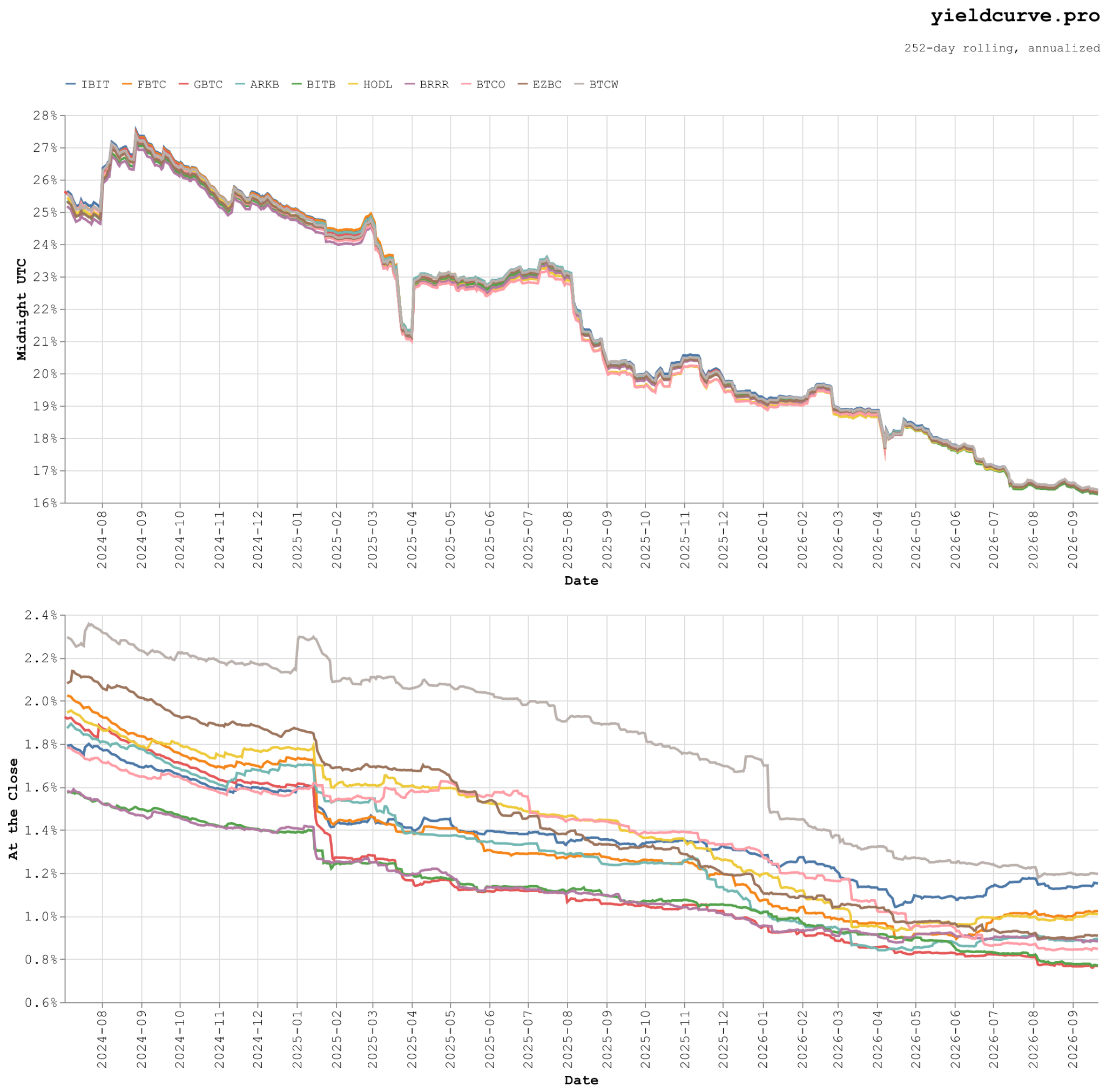
*Figure 1: Rolling 252-day tracking error, midnight-UTC bitcoin (top) vs "Bitcoin at the close".*
The updated tracking errors have fallen for two years. The ETF tracking errors
ran at 1.4% to 2.1% in 2024, 1.0% to 1.7% in 2025, and 0.7% to 1.2% so far in
2026.
## The Yardstick
As a comparison we computed tracking errors for SPY, IVV, and
VOO, the three largest S&P 500 ETFs. We used closing prices without
dividend adjustments and dropped the days each ETF paid a dividend. SPY
measures 0.87%, IVV at 0.97%, and VOO at 0.75%.
One note on data, Yahoo's SPY close for April 9, 2025 is the day's high,
not the close. It sits 1.06% above the last hourly price. State Street's
own NAV and premium history put the close at \$543.44, so we used that.
We then checked every daily close we use against its last hourly price for
consistency. We'd prefer to not look stupid twice.
In Part 1 we wrote tracking error in terms of three quantities, the
volatility of the fund, the volatility of its index, and the correlation
between the two. We then assumed that a fund and its index share the same
volatility, and that a skilled manager can achieve comparable correlation to
the index they are trying to track. Under those assumptions
$$\frac{TE_{BTC}}{\sigma_{BTC}} = \frac{TE_{SPY}}{\sigma_{SPY}}$$
In words, tracking error divided by index volatility should be the same for
equally skilled managers. Table 2 shows that ratio for the three S&P 500
funds and for the largest, tightest, and loosest bitcoin funds.
| Symbol | Tracking error | Index volatility | Tracking error / volatility |
|:-------|------:|------:|------:|
| SPY | 0.87% | 15.3% | 5.7% |
| IVV | 0.97% | 15.3% | 6.3% |
| VOO | 0.75% | 15.3% | 4.9% |
| IBIT | 1.37% | 48.9% | 2.8% |
| BITB | 1.10% | 48.9% | 2.3% |
| BTCW | 1.75% | 48.9% | 3.6% |
*Table 2: Price-based tracking errors, volatilities, and ratios.*
Measured the same way, the largest S&P 500 ETF and the largest bitcoin ETF
are half a point apart.
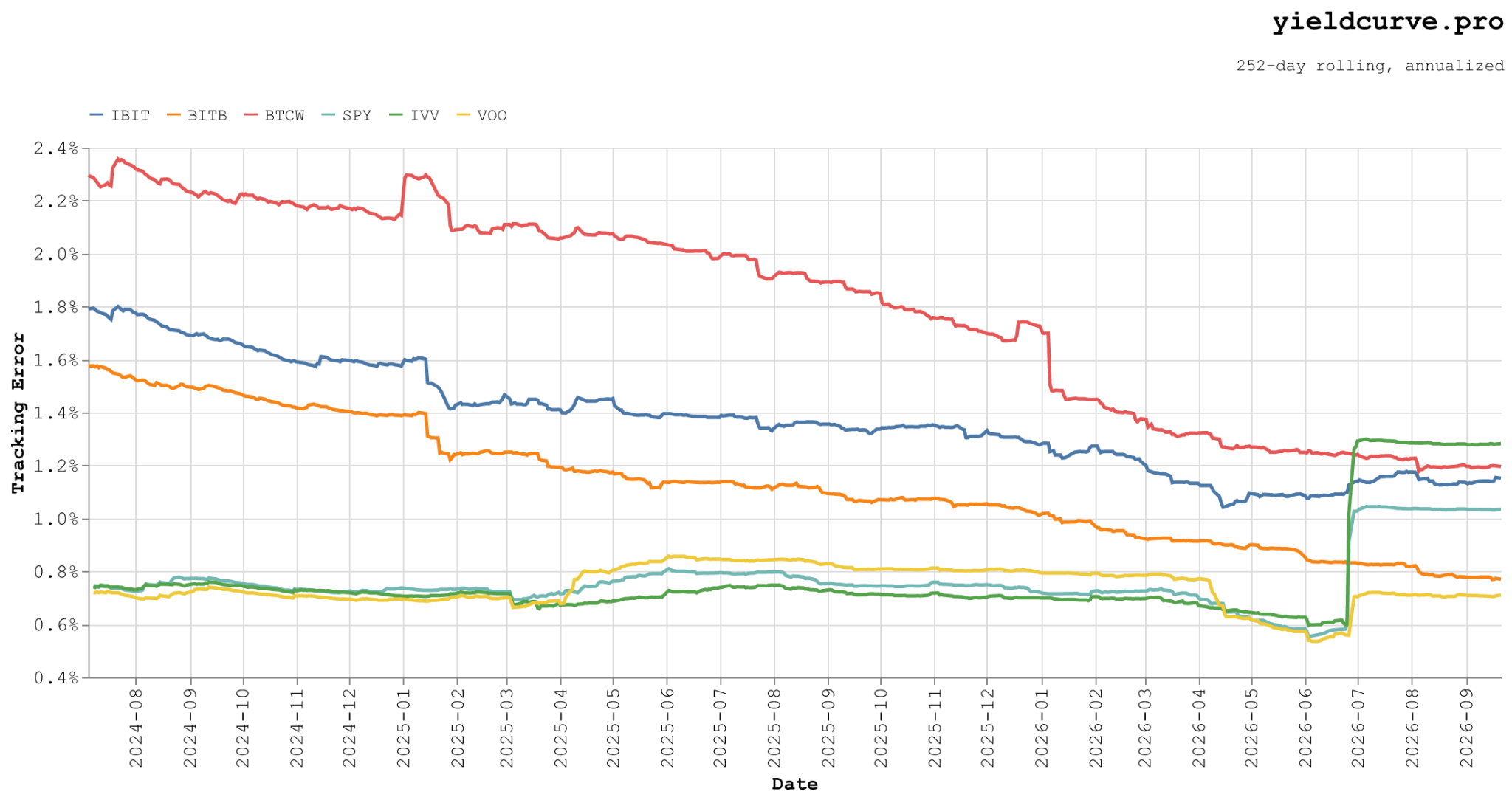
*Figure 2: Rolling 252-day tracking errors. The June 2026 step up in the equity ETFs is the day SPY closed 0.47% below NAV.*
## Who Tracks Tightest
So which Bitcoin ETF manager does the best job? Table 3 presents a variety
of different measures. The third column shows tracking errors for last 63 trading days.
| Symbol | Full sample | Excluding Jan and Feb 2024 | Latest 63 days | Fee (bps) | Assets (\$B) |
|:-------|------:|------:|------:|------:|------:|
| BITB | 1.10% | 1.02% | 0.66% | 20 | 3.32 |
| BRRR | 1.13% | 1.05% | 0.82% | 25 | 0.49 |
| GBTC | 1.19% | 1.01% | 0.64% | 150 | 11.01 |
| ARKB | 1.28% | 1.18% | 0.89% | 21 | 2.68 |
| BTCO | 1.30% | 1.26% | 0.78% | 25 | 0.41 |
| FBTC | 1.34% | 1.20% | 1.24% | 25 | 13.87 |
| IBIT | 1.37% | 1.28% | 1.31% | 25 | 67.91 |
| HODL | 1.39% | 1.28% | 0.91% | 20 | 1.27 |
| EZBC | 1.39% | 1.31% | 0.90% | 19 | 0.43 |
| BTCW | 1.75% | 1.65% | 1.12% | 25 | 0.17 |
*Table 3: Annualized tracking error against "Bitcoin at the close". Fees and assets as of September 21, 2026.*
Bitwise is the tightest in the group. It is first over the full
sample, first excluding the launch months, and second over the latest
quarter. Fees have not moved since our first post. GBTC still charges 150 bps
and the rest charge 19 to 25 bps. Grayscale also launched a cheaper Bitcoin Mini
Trust (ticker BTC) in July 2024. We left it out to keep the original uninverse
intact. Assets under management appear to have nothing to do with efficacy.
IBIT holds about two thirds of the money in the table and sits seventh on tracking error.
## What Part 1 Got Right
Our first post named three suspects. They were trading hours, fees, and the
lack of a closing auction. It guessed the first two did not matter. The
order was backwards. Trading hours were the whole story.
We asked anyone who knows how these funds are run to educate us. Nobody
wrote in, so we educated ourselves. The [Feedback](mailto:info@yieldcurve.pro?subject=Feedback) line is still open.